Friday, October 22, 2010

October 22, 2010 - The Soul of Seattle


A nearly full moon and Jupiter overlook the International Fountain located in the heart of the 87 acre Seattle Center grounds. Seattle Center was the location of the 1962 World's Fair. Some 10 million visitors attended the profitable fair. Funds for the preparations came largely from bonds totalling some $15 million. One of the many legacies of the fair includes the buildings and public spaces at the Seattle Center that remain. These include the Space Needle, monorail, auditoriums, an opera house, a performing arts center and civic center. In the middle of the space is a large, open public space with the International fountain as its focal point. Seattle Center is purportedly the fourth largest visitor's center in the US and is considered by many to be the soul of Seattle, with the International Fountain being Seattle's front lawn.

Tuesday, October 19, 2010

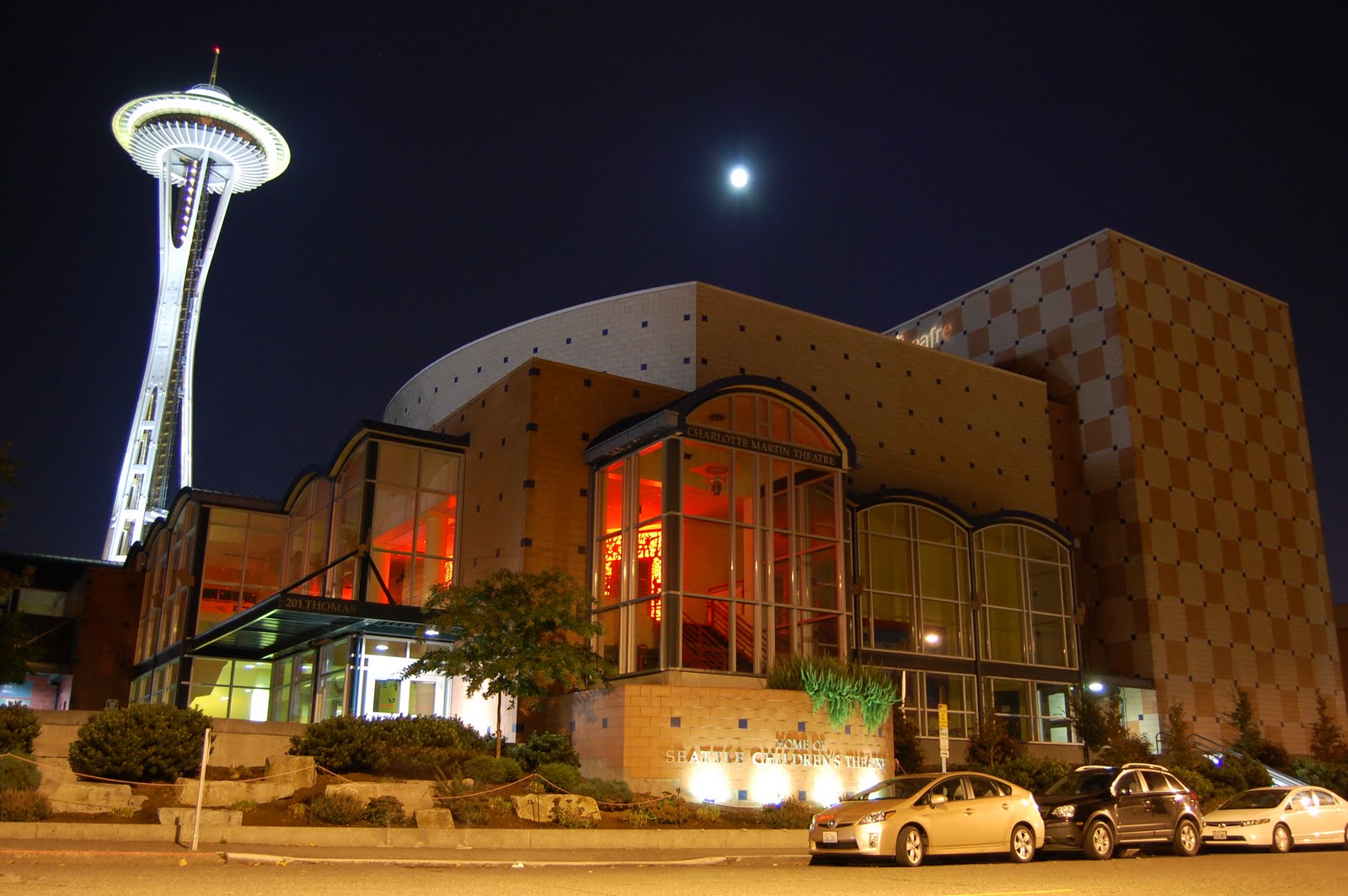
October 19, 2010 - Playhouse


The Seattle Children's Theatre (SCT) complex is a Seattle gem located in the shadow of the Space Needle. The SCT complex was the first self-contained theatre complex built for young audiences. It includes the Allen Family Technical Pavilion, opened in 2000, the 482 seat Charlotte Martin Theatre that opened in 1993 and the 275 seat Eve Alford Theatre that opened in 1995. Each year some 200,000 tickets are sold by this professional theatre company for works that entertain young and old alike.

Wednesday, October 6, 2010

October 6, 2010 - Half of "Father and Son"


As the sun sets beyond the Olympic Mountains, only the son in “Father and Son” by Louise Bourgeois, is visible. The fountain has two stainless steel figures – a father and a son. The water feature changes each hour, rising to hide the son and lowering to reveal the father. The fountain is located at the Olympic Sculpture Park, a 9 acre outdoor sculpture museum and beach located at the north end of Seattle’s seawall. The park is operated by the Seattle Art Museum.


The fountain is located at the Olympic Sculpture Park, a 9 acre outdoor sculpture museum and beach located at the north end of Seattle’s seawall. The park is operated by the Seattle Art Museum.


Sunday, September 26, 2010

September 26, 2010 - Dreaming in Color


The Kreilsheimer Promenade at the Marion Oliver McCaw Hall opera house at Seattle Center as illuminated by Leni Schwendinger’s “Dreaming in Color.”

The opera house was originally opened in 1962 for the World’s Fair. After a dramatic $127 million renovation it was reopened in June 2003. The 2900 seat hall is home to the Seattle Opera and the Pacific Northwest Ballet. The building architects were LMN Architects.


The Kreilsheimer Promenade incorporates the lobby’s five story, 130 feet long, serpentine glass wall, a horizontal water feature designed by Gustafson Guthrie Nichol and translucent metal scrims lit in four changing color compositions into a welcoming portal into not just the opera house, but into Seattle Center.


The water feature consists of three, 48 foot long stone panels tilted subtly towards the lobby. A thin layer of water flows from stone benches across the panels and into a metal grill.


“Dreaming in Color” incorporates nine, 30 foot tall metal screens, similar in design to a fireplace screen, that are suspended 12 feet above the walkway. The lighting on the scrims cycle through four color compositions—“Aquamarine, A Beguiling Song,” “Sleepwalk Into Primary Red-Blue-Green,” “Within the Northern Lights” and “Of Rothko, Section and Plane”. The color compositions were designed how music is written with the horizontal axis being time and the vertical axis being the scrims – the musical instruments of the installation.


The Opera House was originally referred to as the “House that Suds Built”. James Osborne, a saloon owner, bequeathed $20,000, an amount equal to the entire city budget, to the City of Seattle in 1861. These funds were to be used to create a forum for civic and art events and had one requirement – the city had to match his contribution. In 1886 David and Louisa Denny donated the land that would eventually become Seattle Center for public use. The land went undeveloped and Mr. Osborne’s gift grew in interest for 41 years. A city bond was passed in 1927 that raised $900,000 to match Mr. Osborne’s requirement. The resulting “public use forever” improvements brought to the city a baseball, track and football field and a civic auditorium. In 1959, work began on the auditorium that would transform it into the opera house for the 1962 World’s Fair.