Showing posts with label Seattle Center. Show all posts

Saturday, July 16, 2016

July 15, 2016 - Taste Them All


Tends of thousands of people were on hand at Seattle Center for the first day of the long weekend of "The Bite of Seattle", or simply "The Bite", a free food festival.  The event was first held in Green Lake in 1982, and 25 restaurants participated with an estimated 75,000 attendees.  The event was later moved to Seattle Center.  The event has grown over the years.  This year over 60 restaurants will be participating and in addition to the dozens of food options, features beer and wine tasting, beer and wine drinking, five entertainment stages, cooking demonstrations by celebrity chefs and even outdoor movies at night.


Saturday, March 26, 2016

March 25, 2016 - Fountain of Seseragi


Tucked into a corner of the primary green space at Seattle Center is a small water feature, the Fountain of Seseragi by Gerard Tsutakawa. Seseragi, or "murmuring waters", is a bronze sculpture featuring a terraced fountain with v-shaped troughs.  The two streams of water gently converge and circulate as one.  The nearby International Fountain is a completely different type of water feature that commands the attention of visitors.  Its powerful and playful water nozzles, choreographed to music, shooting water blasts that seem to reach nearly as high as the overlooking Space Needle.   By contrast, the Fountain of Seseragi was installed in 2000 and presents a quiet, peaceful, intimate space where one can view Seattle Center visitors in an almost detached fashion.

If you've ever attended a Mariner's game at Safeco field you've likely seen another work by Mr. Tsutakawa.  He is the artist behind the 9 foot high bronze sculpture "Mitt" located outside of the left field entrance.

(The  fountain was in a post in May of 2011, but the original file has since been lost.)


Wednesday, January 28, 2015

January 28, 2015 - Wednesday Before The Sunday


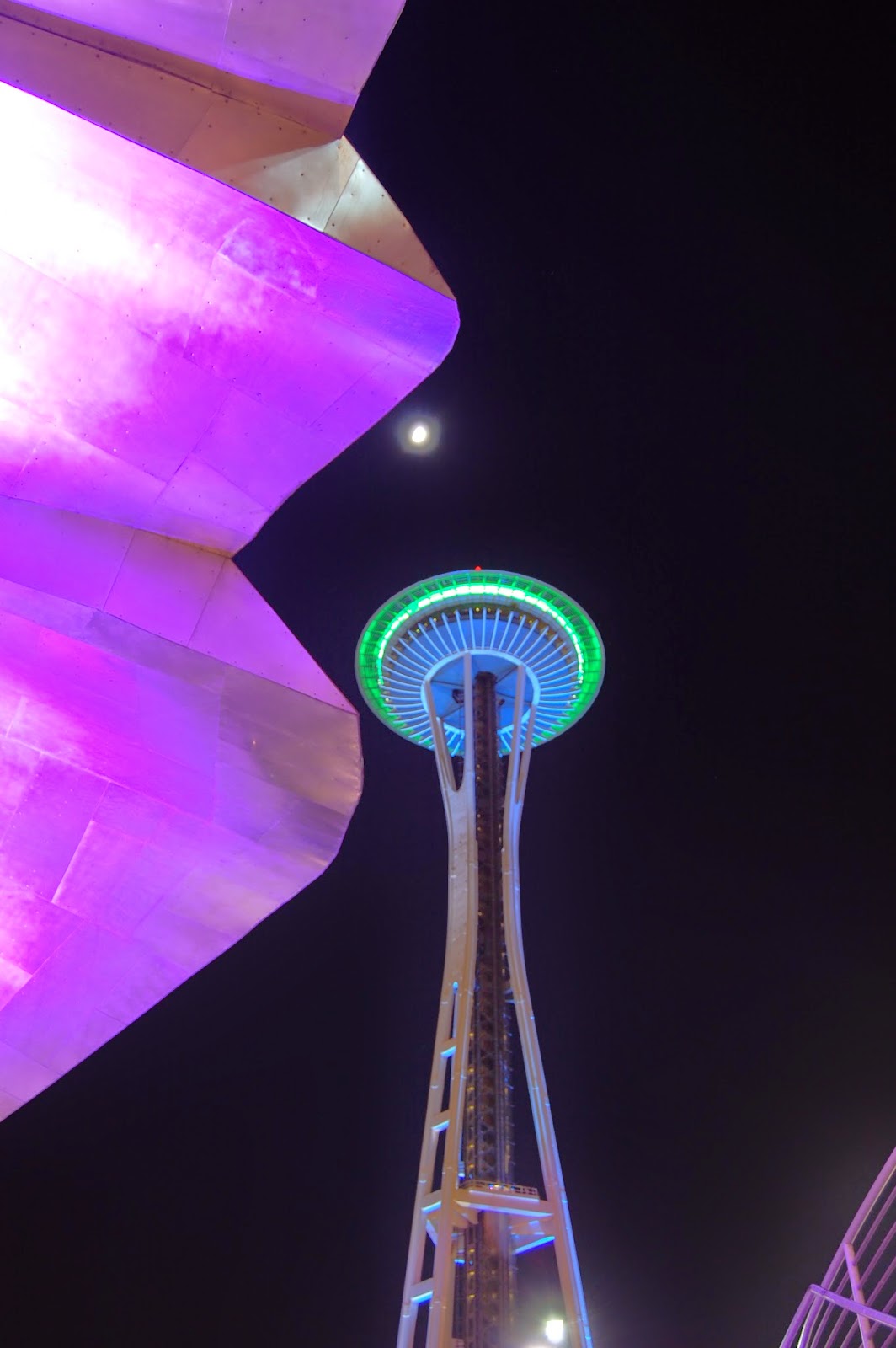
Civic pride in the local football club can be seen in buildings throughout the area as Super Bowl XLIX gets closer.  Office buildings, construction cranes and of course the Space Needle, are illuminated in Seahawk blue and green.


Wednesday, March 26, 2014

March 26, 2014 - Sonic Bloom


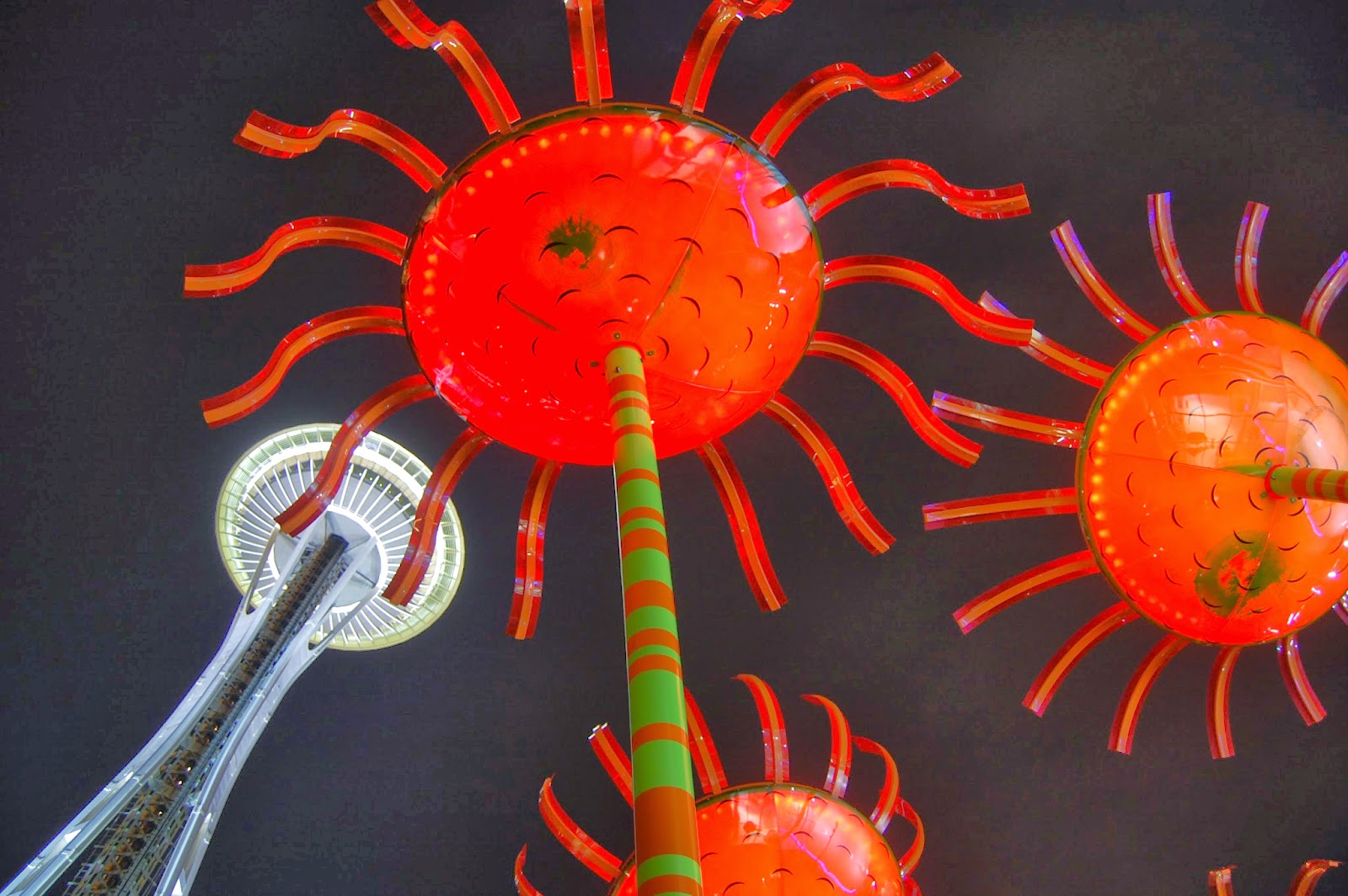
Dan Corson's "Sonic Bloom", solar powered art installation outside of the Pacific Science Center, was installed in 2012 to commemorates the center's 50th year of discovery.  The 33' high flowers glow during the day and light up in vivid, changing colors at night.  


March 26, 2014 - Mural Mural on the Ground


The mural of Seattle Center's Mural Amphitheater as reflected in a puddle on the amphitheater's stage.

Paul Horiuchi was commissioned to create a mural for the 1962 World's Fair.  The 17' x 60' work of art, "Seattle Mural" was initially placed over a pool and surrounded by some of the fair's temporary structures.  Mr. Horiuchi's "Seattle Mural" is a collage made of 160 color variations of Venetian glass installed on 54 panels.  The mural design began with pieces of colored paper torn and made into a collage.  It was intended to evoke the natural beauty and colors of the northwest.  It now provides a recognizable backdrop for dozens of public concerts, festivals and gatherings held each year at Seattle Center. If you knew of a band from Seattle, chances are they've played in front of this mural.

{Here is a 50 minute concert Pearl Jam played 8/23/1991, several days before the release of their first album "Ten". https://www.youtube.com/watch?v=hKFzoSWKnzg}

Mr. Horiuchi has a story not that unusual for Japanese Americans of his generation.  He was born and raised in Japan while his father worked for the Union Pacific Railroad in Wyoming.  In 1920, at the age of 16, he got on a boat to the US to join his parents, meet his father and his three younger siblings.  Mr. Horiuchi did well working for the railroad, but when the Japanese employees of the railroad were fired and evicted from company housing following the attack on Pearl Harbor.  As he was outside of the exclusion zone imposed by Executive Order 9066, Mr. Horiuchi wasn't placed in a relocation camp as many Japanese Americans on the West Coast were.  He scraped by supporting his young family with whatever work he could secure.  Things were bad enough that they actually applied to be placed in a relocation camp.  They were denied.

Following the war, Mr. Horiuchi opened an auto body shop in Seattle's International District.  For Mr. Horiuchi, art was a hobby.  His work had been recognized at regional art shows, but in 1950 a financial crisis compelled him to sell some paintings.  He quickly found that that there was a lucrative market for what had been his hobby.  He was able to sell his auto body business and start a new career in art.


Wednesday, August 21, 2013

August 21, 2013 - International Fountain


Seattle Center's International Fountain is a great place to cool off on a warm August afternoon.  The fountain seems to draw out the inner kid in parents, chaperones and other responsible adults as everyone that ventures into the fountain's bowl ends up getting at least a little wet and for most, a lot wet! 

Kids in street clothes start out flirting with the fountains spray, but end up just as wet as those in swimsuits.  And kids in swimsuits with umbrellas....they get soaked through!

The fountain was built in 1961 for the 1962 World's Fair and was rebuilt into the current configuration in 1995.  The original rocky mound replaced with a smooth silver dome.  The Seattle Center claims that the 9,000 gallons of recycled water pumped through the 137 nozzles is some of the cleanest in the city going through 3 separate treatments.  Not that anyone seems to notice!


Friday, May 13, 2011

May 11, 2011 - Murmuring Waters

Rain. A fountain. A water feature.  If the rain wasn't enough, the International Fountain (in the background) and the Fountain of Seseragi are very visual reminders that the Pacific Northwest is a water culture.  The cool, wet, gray day (or the fountain and water feature) didn't seem to dampen the spirit of the dozens of  kids on a school field trip running around Seattle Center.

The Fountain of Seseragi by Gerard Tsutakawa was installed in 2000.  Seseragi, or "murmuring waters", is a bronze sculpture featuring a terraced fountain with v-shaped troughs.  The two streams of water gently converge and circulate as one.  It is located on the South side of the Intiman Theatre.  If you've attended a Mariner's game at Safeco field you've likely seen Mr. Tsutakawa's 9 foot high bronze sculpture "Mitt".

Sunday, March 6, 2011

March 5, 2011 - Moon Gates

Doris Totten Chase's 17 foot high "Moon Gates" is a bronze sculpture installed at the base of Seattle's Space Needle in 1999.  Doris Chase (1923-2008) was a Seattle native whose work in art began with painting and sculpture.  In the early 1970s she was a pioneer in the area of video art.  Ms. Chase's sculpture "Changing Form", was installed at Kerry Park on Queen Anne Hill in 1971. (See December 6, 2010 - "Needle Topper" for a view of Kerry Park and May 1, 2009 - "Changing Form as Frame" for the lines of that sculpture.)

March 5, 2011 - Black Lightning

Ronald Bladen's (1918-1988) minimalist Black Lightning, a 60 foot long 24 foot high painted metal sculpture installed at the base of the Space Needle in 1981, contrasts sharply to the fusion of colors, shapes and textures present in the Frank Gehry designed Experience Music Project in the background.

Mr. Bladen is viewed as one of the cool fathers of "Minimalism".  He wanted his signature works to have presence and his signature was massive black forms that had an air of light, speed and weightlessness.  Mr. Bladen was born in Vancouver, BC, and lived, for part of his childhood in Hoquiam and Aberdeen, Washington.  During WWII he worked in the dockyards as a toolmaker, which helped to support his painting.  It wasn't until the 1960s that he began working as a sculpture, utilizing the skills he learned at the dockyards.

Saturday, March 5, 2011

March 5, 2011 - Merry No More


A section of one of the panels on a merry-go-round in the kiddieland section of Seattle Center's dismantled Fun Forest sits idle at the base of the Space Needle.  A Chihuly exhibit was selected to occupy this acre of Seattle Center.  The exhibit will be opened in time for the 50th anniversary of the 1962 World's Fair.  The Space Needle and many of the structures at Seattle Center were built for the 1962 World's Fair.

The 44,00 square foot structure - a glass house - will exhibit some $50 million of Chihuly art and is expected to draw a thousand visitors a day.  The public-private venture was proposed by the owners of a nearby privately owned venue, the Space Needle. The Chihuly museum, is to be built with private funds and the land leased by Seattle Center for 20 years.

UPDATE: The museum opens May 21, 2012.

March 5, 2011 - Parallax Totem

This totem pole carved by Duane Pasco, Victor Mowatt and Earl Muldoon was installed at Seattle Center in 1970.  The animals represented on the pole include a hawk, a bear with a salmon, a raven and a killer whale.  The totem pole can be seen in Alan Pakula's opening sequence of the 1970 film "The Parallax View" staring Warren Beatty.  The film was the second in director Pakula's political paranoia trilogy; "Klute" (1971) and "All the President's Men" (1976) being the other two.  The opening scene takes place at a Fourth of July parade for a prominent Senator who in short order is assassinated at the top of the Space Needle.  However, the foilage clearly visible in the trees indicates the film was made on an early spring day, such as this one.  The movie is a classic and if you have ever been to the Space Needle you should see the film for no other reason than to see what Seattle and the observation deck looked like forty years ago.

Saturday, February 19, 2011

February 19, 2011 - Roots and Branches

Towering inside of the Experience Music Project is "If VI were IX: Roots and Branches" by Trimpin, a working artwork consisting of over 500 musical instruments.  Robotic arms coordinated by computer pick strings of numerous instruments within the work to create a continuous soundscape composed by the artist.

One of the exhibits, "Guitar Gallery: Quest for Volume" traces the evolution of the guitar from 1770 to today through more than 50 extremely rare guitars including (from left to right) a 1959 Fender Jazzmaster, a 1955 Gretsch 6120 and a 1957 Fender Flying V Prototype.

The Experience Music Project - Museum of Music, Sci-Fi and Pop Culture - is housed in a 140,000 square foot near the base of the Space Needle at Seattle Center.  The unique building, designed by Frank O. Gearhy, was inspired by his use of the pieces he had cut out of several electric guitars.  Local firm LMN Architects was the Associate Architect on the project.

Current exhibits include: "Guitar Gallery: Quest for Volume" and "Jimi Hendrix: An Evolution of Sound" and "Battlestar Gallactica: The Exhibition".  There is also an interactive Sound Lab in which one can be guided through an exploration of the tools of rock.  Coming in April is "Nirvana: Taking Punk to the Masses".  In June, "Avatar: The Exhibition" will open.

The founder of EMP, Paul Allen, is a huge fan of rock and roll and of science fiction.  His collection of rock and roll memorabilia, including that of Seattle's Jimi Hendrix, led to the creation of EMP. Over 4.5 million people have come through the EMP since it opened in 2000.

Friday, October 22, 2010

October 22, 2010 - The Soul of Seattle


A nearly full moon and Jupiter overlook the International Fountain located in the heart of the 87 acre Seattle Center grounds. Seattle Center was the location of the 1962 World's Fair. Some 10 million visitors attended the profitable fair. Funds for the preparations came largely from bonds totalling some $15 million. One of the many legacies of the fair includes the buildings and public spaces at the Seattle Center that remain. These include the Space Needle, monorail, auditoriums, an opera house, a performing arts center and civic center. In the middle of the space is a large, open public space with the International fountain as its focal point. Seattle Center is purportedly the fourth largest visitor's center in the US and is considered by many to be the soul of Seattle, with the International Fountain being Seattle's front lawn.

Sunday, September 26, 2010

September 26, 2010 - Dreaming in Color


The Kreilsheimer Promenade at the Marion Oliver McCaw Hall opera house at Seattle Center as illuminated by Leni Schwendinger’s “Dreaming in Color.”

The opera house was originally opened in 1962 for the World’s Fair. After a dramatic $127 million renovation it was reopened in June 2003. The 2900 seat hall is home to the Seattle Opera and the Pacific Northwest Ballet. The building architects were LMN Architects.


The Kreilsheimer Promenade incorporates the lobby’s five story, 130 feet long, serpentine glass wall, a horizontal water feature designed by Gustafson Guthrie Nichol and translucent metal scrims lit in four changing color compositions into a welcoming portal into not just the opera house, but into Seattle Center.


The water feature consists of three, 48 foot long stone panels tilted subtly towards the lobby. A thin layer of water flows from stone benches across the panels and into a metal grill.


“Dreaming in Color” incorporates nine, 30 foot tall metal screens, similar in design to a fireplace screen, that are suspended 12 feet above the walkway. The lighting on the scrims cycle through four color compositions—“Aquamarine, A Beguiling Song,” “Sleepwalk Into Primary Red-Blue-Green,” “Within the Northern Lights” and “Of Rothko, Section and Plane”. The color compositions were designed how music is written with the horizontal axis being time and the vertical axis being the scrims – the musical instruments of the installation.


The Opera House was originally referred to as the “House that Suds Built”. James Osborne, a saloon owner, bequeathed $20,000, an amount equal to the entire city budget, to the City of Seattle in 1861. These funds were to be used to create a forum for civic and art events and had one requirement – the city had to match his contribution. In 1886 David and Louisa Denny donated the land that would eventually become Seattle Center for public use. The land went undeveloped and Mr. Osborne’s gift grew in interest for 41 years. A city bond was passed in 1927 that raised $900,000 to match Mr. Osborne’s requirement. The resulting “public use forever” improvements brought to the city a baseball, track and football field and a civic auditorium. In 1959, work began on the auditorium that would transform it into the opera house for the 1962 World’s Fair.


Saturday, March 27, 2010

March 27, 2010 - More Spring Blossoms


While some trees are in bloom others are still bare. The Space Needle soon won't be visible from this spot near the Kobe Bell and the Intiman Playhouse at Seattle Center.

Saturday, February 27, 2010

February 26, 2010 - Needle in Reflection


The Space Needle is reflected off of the windows of the Pacific Science Center. The Pacific Science Center, like the Space Needle, was a legacy of the 1962 World's Fair. It is an independent, non-profit museum dedicated to making science fun and accessible to all. The Pacific Science Center complex held the United States Science Pavillion for the World's Fair. Minoru Yamasaki was the architect. He is perhaps best known for his work in designing the World Trade Center in New York City.

Friday, February 26, 2010

February 26, 2010 - Olympic Inspiration


"Olympic Iliad" by Alexander Liberman was installed at Seattle Center in 1984. The monumental sculpture comprising red painted steel cylinders stands 45 feet high and is 60 feet wide.

Wednesday, February 10, 2010

January 10, 2010 - The Space Needle and The Grass Blades


The Space Needle rises above "The Grass Blades" at Seattle Center.  The Space Needle is 605' high and opened in 1962.  It cost $4.5 million to build.  Edward E. Carlson was the Artist.  Susan Zoccola's work "The Grass Blades" was a partnership with RBF Architects, (project lead John Fleming) that resulted in an AIA award.  The 110 30-foot high steel blades gently sway in the breeze and form an effective visual barrier between the EMP and a nearby parking lot.  "The Grass Blades" were installed in September 2002.  Also viewable through the grass is the Northeast 'corner' of the Experience Music Project, founded by Paul Allen. The building was designed by Frank Gehry with the associate architects LMN Architects. It is 85' high, 140,000 square feet, it opened in 2000.