Showing posts with label Bainbridge Island. Show all posts

Sunday, April 11, 2021

April 10, 2021 - Bloedel Reserve


The 150 acre Bloedel Reserve on Bainbridge Island is considered one of the top botanical gardens in the country.  Two miles of well maintained trails take visitors through 23 distinct landscapes including a meadow, woodlands, marshland, glen, moss garden, Japanese garden and a reflecting pool.  

The residence, an18th century French inspired design, was built in 1929 as a summer home for a prominent Seattle family.  It was purchased by Prentice and Virginia Bloedel in 1951.  Born in Bellingham in 1900, Mr. Bloedel attended Yale and went into teaching, but gave it up to join the family timber business.  

He was a pioneer in the industry for his recycling innovations including reforestation.  In 1938, his firm became the first lumber company to plant seedlings.  By 1948 they were responsible for 70% of all reforestation efforts in the private sector in British Columbia.  

The reserve has been shaped by a number of noted landscape architects and designers, including Thomas Church, a pioneer in Modernism in landscape design, Richard Haag, who later started the Landscape Architecture Department at the University of Washington and Fujitaro Kubota, who developed Seattle's Kubota Garden.

The property was donated to the University of Washington in 1970.  A foundation was later created to purchase and maintain the reserve.  Prentice passed away in June of 1996 at the age of 95.  His wife, Virginia, passed away in 1989.

The Bloedel Reserve is far from their only legacy to the Seattle area.  The Japanese Gardens at the Washington Park Arboretum was made possible by their giving.  Their daughter, Virginia, and her husband were top art collectors for decades and have been instrumental in the growth of the Seattle Art Museum.  


April 10, 2021 - Scenic Start


The sights from a ferry crossing Puget Sound - the Great Wheel, the Space Needle, the changing skyline, the mountains, the ships and boats - can be at least as scenic as your destination.  The excursion this day started aboard the M/V Walla Walla for the 35 minute crossing to Bainbridge Island.


The M/V Sealth heads west to Bremerton, a route that takes it around the southern end of Bainbridge Island.


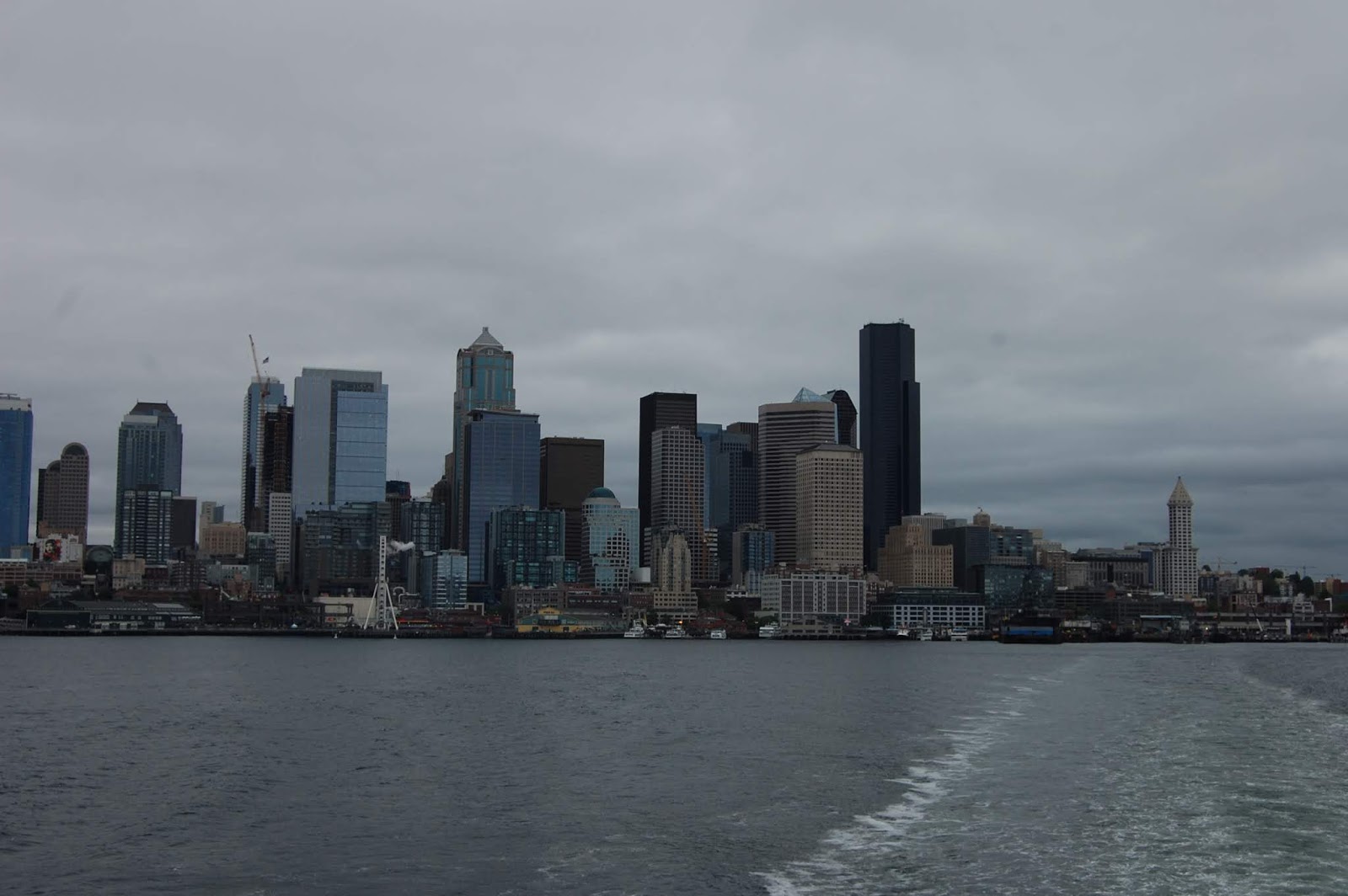
The skyline  continues to evolve  between the bookends of downtown, the Smith Tower, built in 1914, and the Space Needle, built in 1961.  At the time each of those structures was built they became the tallest building west of the Mississippi.  Currently there are about 43 cranes in Seattle, tied with LA for the second most in the country.  (The crane at the Climate Pledge Arena, due to open this fall, just recently came down.)  

The demolition of the double-decker Alaskan Way Viaduct was completed in November of 2019.  This has accelerated the opportunities for development to connect downtown with the waterfront.  (For reference, the photo of the skyline and waterfront was taken in 2009.)   


Two 35,000 ton Panama-flagged bulk carriers were anchored in Elliott Bay.  The Omishima Island, recently arrived from San Marcos, Mexico and the brand new Juno Avenir, recently arrived from Niigata, Japan.  


The Marshall Foss, one of 90 tugboats in Foss Maritime fleet, heads to another job.  Thea Foss started the business in 1889 in Tacoma with one rowboat she painted a sharp green and white.  Before expanding into powered tugboats, the company fleet was made up of rowboats, many built by her husband.  Today the Foss name can be seen in ports throughout North America.


The M/V Suquamish heads to Seattle, passing her partner on the Seattle-Bainbridge run.


Retired ferries, including the M/V Klahowya and M/V Hyak, at the Bainbridge ferry terminal.

Sunday, May 26, 2019

May 25, 2019 - Let It Not Happen Again


On a cool, rainy day, the colorful chains of paper cranes at the Bainbridge Island Japanese American Exclusion Memorial hang in stark contrast to the gray clouds and the old growth cedar, granite and basalt memorial wall bearing the names of the 227 Japanese-Americans that were ordered off Bainbridge Island and into internment camps as part of Executive Order 9066.  They were the first of 120,000 Japanese-Americans living in the west coast that were forced into interment camps.  Bainbridge Island is a short ferry ride across Puget Sound from Seattle.

At this site on March 30, 1942, with just six days notice, the entire Japanese-American population of flanked by soldiers with bayonets on their rifles, filed onto the ferry Kehloken.  Left behind were homes, farms and businesses.  Their belongings were limited to the clothes they could wear or carry in a single suitcase. 

At the end of the war about 150 residents returned to the island.  Some were lucky enough to regain their farms and homes due to the kindness of local caretakers.  Others had lost all that they had built.

The National Parks Historical Site is a unit of the Minidoka National Historic Site in Idaho, one of several interment camps.   It opened to the public in July of 2011.  The wall was designed by Johnpaul Jones, a local Native American architect.  It contains the names and ages of all 227 forced off the island as well as friezes depicting some of the scenes from that morning.

The site is dedicated to those who suffered and those who supported and stood by the Nissei forced off the island and to the ideal of safeguarding our constitutional rights for all. Nidoto Nai Yoni - "Let it not happen again."